
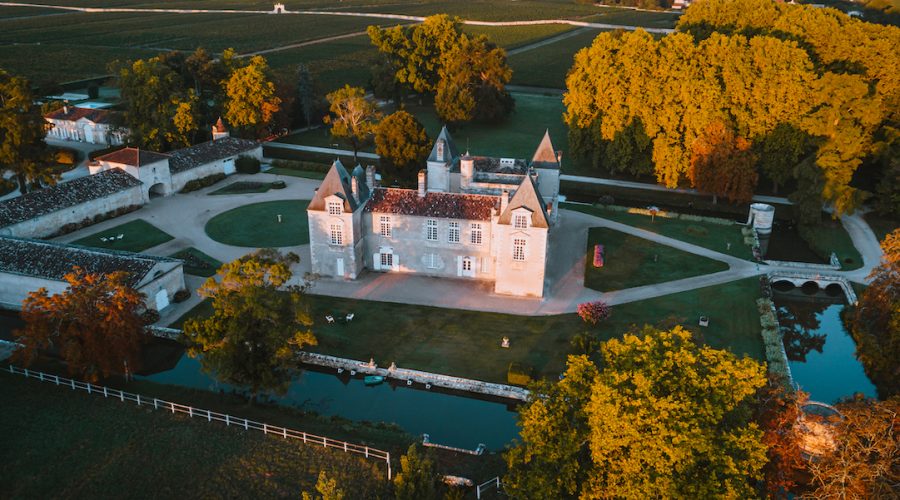
Chateau D'Issan

Open for visits and tastings from Monday to Friday by appointment.
From 8 am to 12.30 am and from 1.30 pm to 5 pm.
Closed on weekends and public holidays.
Only private tours are being offered in French, English, Spanish.
Tasting options include:
Horizontal
Duration: 1 h 30 m
Discover Château d’Issan and Blason d’Issan made in the same year.
La Familiale
Duration: 1 h 30 m
Taste Château d’Issan, Blason d’Issan, Haut-Médoc d’Issan, Moulin d’Issan.
Château d’Issan is nestled within the robust 17th-century walls of a classic French château, elegantly surrounded by a picturesque moat.
This historic estate is renowned for its third-growth winery, proudly listed in the prestigious 1855 Imperial Classification, making it a significant player in the Margaux appellation. Situated in Margaux, Château d’Issan benefits from a temperate climate influenced by its proximity to the sea and the Gironde Estuary, alongside the region’s gravel and alluvial soils that provide optimal conditions for vine growth.
The estate spans 67 hectares (approximately 141 acres), with 52 hectares (about 109 acres) dedicated to the Margaux appellation, while small plots are also cultivated in Haut-Médoc and Bordeaux Supérieur. The average age of the vines is around 35 years, contributing to the quality of the wine produced.
The château’s history is rich and complex, tracing back to the 12th century. The current structure was erected in the 17th century by Baron d’Essenault, who, along with his family, lent the estate its name. Over the years, ownership of Château d’Issan changed hands through inheritance and marriage. The estate faced significant turmoil during the French Revolution, leading to its abandonment by the Foix de Candale family. In the 20th century, particularly during the World Wars, the estate fell into disrepair. However, since 1945, under the stewardship of the Cruse family, Château d’Issan has undergone extensive restoration, modernization of its facilities, and replanting of its vineyards. In 2012, Françoise and Jacky Lorenzetti, who also own Château Lilian Ladouys in Saint-Estèphe and Château Pedesclaux in Pauillac, acquired a stake in Château d’Issan, further enhancing its development with a new winery. An interesting aspect of the harvest is the collaboration with a Danish school, where around fifty students come from Denmark to participate in the hand-harvesting process, highlighting the château’s commitment to community and education in viticulture.
Château d’Issan is made from the old vines in the middle of the Margaux appellation. The soil made up of surface gravel on top of a clay subsoil contributes to optimal ripeness and freshness of Cabernet Sauvignon and Merlot. Château d’Issan is aged in barrels for 16 to 18 months, half of which are new. Annual production is around 100,000 bottles.
Blason d’Issan, the second wine introduced in 1995 is made from the youngest vines. Blason d’Issan is also aged in barrels for 14 to 16 months, one-third of which are new. Annual production is around 120,000 bottles.
Le Haut-Medoc d’Issan. This wine is made from fruit grown on plots 5 km (3 miles) west of the estate in Arsac in the Haut-Médoc appellation. It uses the dominant Medoc grape varieties, Cabernet Sauvignon and Merlot.
Moulin D’Issan comes from an area known for its variety of soil types and sub-soils. Here, Bordeaux Supérieur AOC plots are located. The soil there is mainly clayey limestone and therefore particularly suited to the Merlot grape variety which contributes 90% of the blend. Its annual production is about 40,000 bottles.
